
Intelligent Interfaces: The Next Competitive Edge
06 Mar 2026, Posted by in AI, DOME, Technologies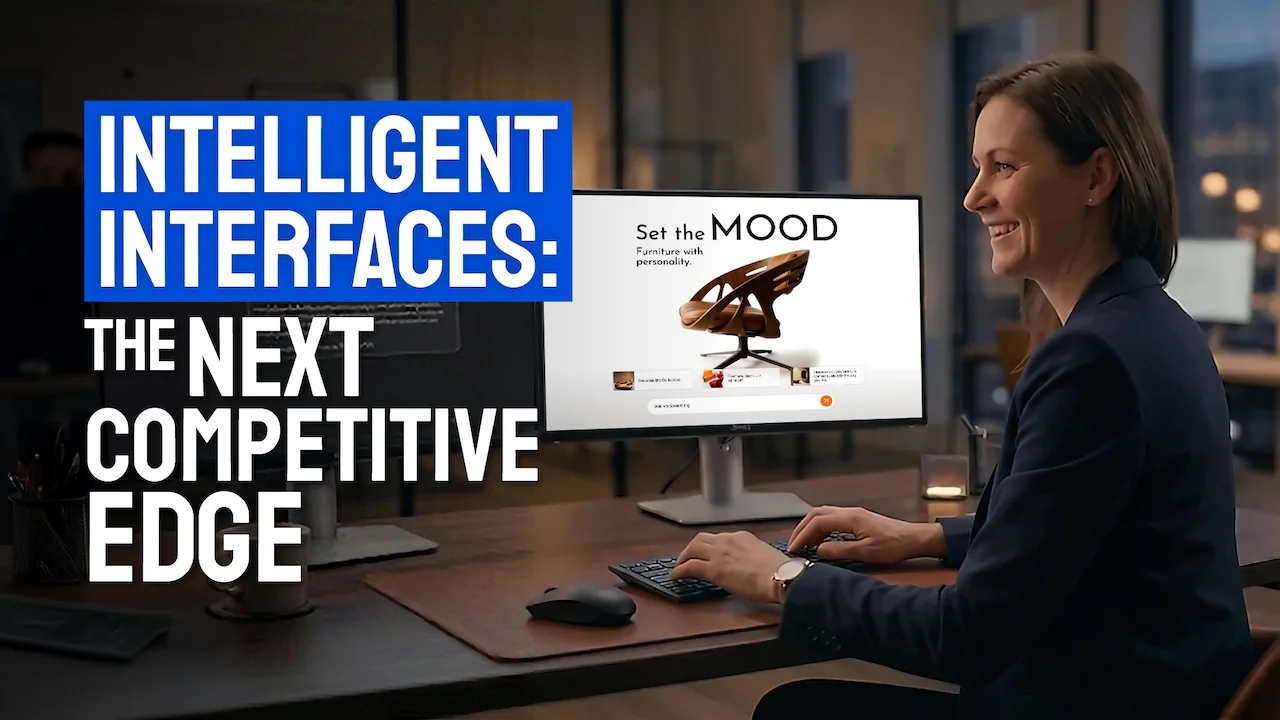
Navigation Is a 1990s Assumption. Your Users Live in 2026.
For 35 years, we’ve built digital experiences around a simple idea, Users browse. We gave them:
- Menus
- Dropdowns
- Categories
- “Resources” sections
- Layered navigation hierarchies
And for a while, it worked. But here’s the uncomfortable truth; Navigation is a design assumption from the 1990s. Your users no longer think that way. They don’t want to browse. They want answers.
Static Hierarchies vs. Intent-Based Systems
Traditional websites are built like filing cabinets. Information is organized by internal logic, Marketing, Products, Support, About Us. But users don’t think in org charts. They think in moments:
- “How do I fix this?”
- “Can I see this in blue?”
- “Where’s my order?”
- “What’s the fastest option?”
- “Does this integrate with what I already use?”
When a user has intent, asking them to navigate a hierarchy is friction. Static navigation assumes:
- “I’ll explore until I find it.”
Intent-based systems assume:
- “Tell me what you need. I’ll assemble it.”
That shift changes everything.
Browsing vs. Answering
Browsing is passive. Answering is active.
Browsing requires:
- Scanning
- Clicking
- Backtracking
- Guessing which label hides the right content
Answering requires:
- Understanding intent
- Assembling relevant content dynamically
- Presenting exactly what matters
- Adapting in real time
The rise of AI hasn’t just introduced new tools. It has rewired user expectations. When users can ask ChatGPT, Perplexity, or Gemini a direct question and get an immediate response, they subconsciously expect your brand to work the same way. Not eventually. Not after three clicks. Now.
If your digital experience still assumes exploration over immediacy, you are operating in a different decade than your users.
Why Menus Are Friction Artifacts
This is the part most leadership team’s underestimate. Menus aren’t neutral. They are friction artifacts from an era when:
- Bandwidth was limited
- Personalization was impossible
- Real-time assembly didn’t exist
- AI-driven systems weren’t viable
Today, we can modularize content. We can interpret intent. We can dynamically assemble experiences. We can personalize in real time. Yet most companies still bolt AI onto static systems. A chatbot floating in the corner does not solve structural friction. It just adds another layer to it.
True transformation isn’t about adding AI. It’s about rethinking the interface model. From page-based navigation to Intent-driven response systems, predefined journeys to Adaptive, contextual interaction, and from “One site for everyone” to “A system that adjusts to each person.”
The Leadership Question
This is not a UX tweak. It’s a strategic decision. If your digital presence is your primary interface with customers, partners, students, patients, or members, then the structure of that interface directly impacts:
- Conversion
- Retention
- Support cost
- Brand perception
- Enterprise valuation
The companies that win in the next five years will not be the ones with the flashiest AI demos. They’ll be the ones that re-architect their digital experience around intent. That shift requires:
- Executive alignment
- Architectural clarity
- Governance discipline
- And a willingness to challenge legacy assumptions
Navigation worked for the early web. But the web is being rewritten. The question for leadership teams isn’t: “Can we add AI?” It’s “Are we still designing for 1998 while our users live in 2026?” These are the structural conversations I advise executive teams and boards on as they rethink AI strategy, personalization, and intelligent digital infrastructure.
And when organizations are ready to move beyond discussion into execution, my team at SparxWorks helps translate that strategic shift into operational systems through our DOME service. Because in the age of intelligent interfaces, browsing is optional, but relevance is not.

Sorry, the comment form is closed at this time.